
Everyday Work Data / Ego2Robot / arXiv / Aug 17, 2026
From Restocking Shelves to Robot Skills: What Ego2Robot Shows About Everyday Human Data
Routine work such as scanning, sorting, restocking, packing, and tidying contains the hand-object sequences robots need to learn. Ego2Robot shows how first-person demonstrations could be transformed at scale.
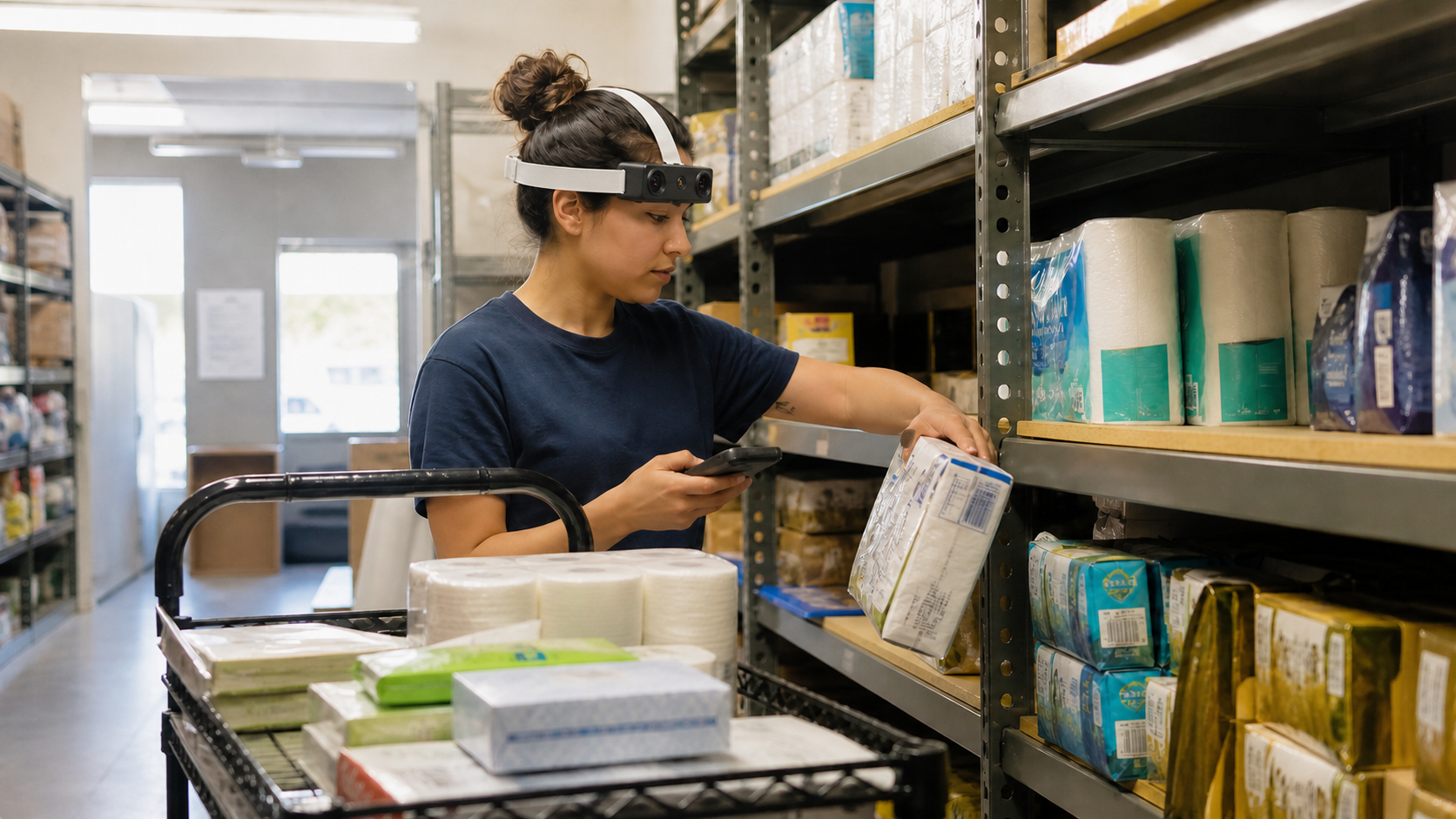
A store associate rolls a cart into a stockroom, scans a package, checks a shelf location, turns the item to face forward, and moves an older product ahead before placing the new one behind it. To a person, this is ordinary work. To a robot-learning system, it is a compact lesson in visual search, sequencing, grasping, orientation, placement, and exception handling.
Released on August 3, 2026, Ego2Robot explores how first-person human manipulation video can be converted into robot-format training data. The research pipeline uses action retargeting, robot-arm visual synthesis, and several stages of quality curation. It reports 18,561 hours of synthesized training data across 15 robot morphologies, produced from approximately 1,940 hours of source egocentric video.
The research matters because useful demonstrations are everywhere outside robotics labs. Retail employees restock shelves and prepare displays. Warehouse teams sort parcels and fill totes. Hotel staff arrange rooms and replenish supplies. Small-workshop employees assemble, inspect, and pack products. These familiar tasks contain repeatable hand-object interactions that can be recorded without placing a robot at every location.
Human hands and robot end effectors have different shapes, reach limits, and movement constraints. Ego2Robot aligns human motion with robot actions, changes the visual embodiment, and filters unsuitable outputs. Its experiments report improved generalization when synthesized data is combined with robot demonstrations, especially when appearance, embodiment, or task conditions change.
The quality of the original recording still sets the ceiling. Everyday collection therefore needs visible hands and objects, stable task boundaries, natural but well-framed movement, and examples of ordinary variation such as different shelf heights, package shapes, carts, lighting, and worker approaches.
EGO R9 can support first-person capture in practical workplaces. Its hands-free viewpoint follows the wearer through scanning, sorting, stocking, packing, and inspection. A 120-degree wide-angle view keeps both hands and nearby shelves in context, while 1080P global-shutter video preserves coherent geometry during movement. The 6-axis IMU above 200 Hz, shared clock, and global timestamps connect head motion, image frames, and task markers along one session timeline.
Begin with a small set of repeatable workflows and define the visible start, handling stages, correction events, and completed state for each task. Store the R9 unit identifier, camera angle, selected video mode, intrinsics reference, IMU and timestamp checks, environment label, and file checksum in the session manifest.
Ego2Robot points toward a future where ordinary work can contribute to more adaptable robot policies after careful alignment and curation. For data teams, that makes familiar daily tasks a valuable starting point rather than background activity.