
Fire & Rescue Training / Original EGO R9 field guide informed by the Fire360 firefighter-training benchmark / Sep 14, 2026
Before the Smoke: Fire-Rescue Training Capture with EGO R9
Fire-rescue training drills combine equipment handling, marked routes, team handoffs, and changing viewpoints. This R9 guide uses global-shutter video, high-rate IMU data, shared timing, and local recording for structured dry-drill review.
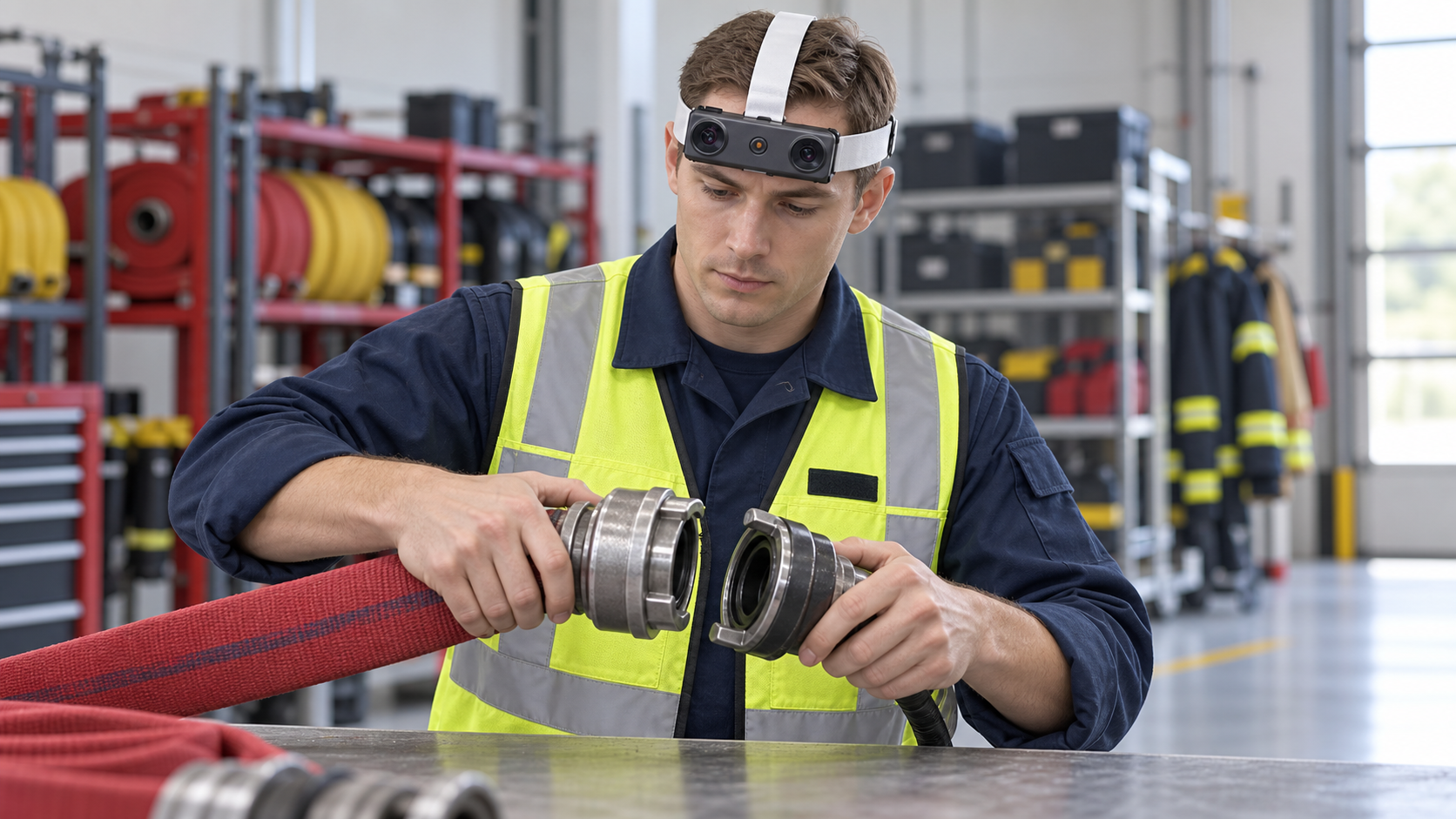
A fire-rescue trainee checks a coupling, advances through a marked doorway, identifies a search point, and returns for a short debrief. An overhead camera may record the room, but it often misses which tool was visible, when the wearer's viewpoint changed, and how one action led to the next. EGO R9 can add a hands-free first-person record to an instructor-led dry drill, helping a team review observable steps while preserving the established training procedure.
Fire360, presented by Tiwari and colleagues, is a benchmark created from professionally recorded firefighter training. Its official project describes 228 videos totaling 50 hours and demonstrates the value of capturing complete task sequences, changing viewpoints, and instructor-defined event labels. This R9 workflow applies those data-quality lessons to a controlled training-bay drill.
A qualified instructor can define a short sequence such as inspecting an unpressurized hose coupling, laying out a training tool, walking a marked route, pausing at a designated search point, returning the equipment, and completing a debrief. EGO R9 records the observable sequence from the trainee's first-person viewpoint.
The head-mounted form keeps both hands available during equipment handling. R9's adjustable camera angle and 120-degree wide-angle lens can include the coupling, gloved hands, nearby tool layout, and part of the route context. Set the angle while the trainee stands, kneels, and looks through the marked doorway, then record the selected position with the session.
R9's confirmed standard mode is 1080P global-shutter video at 30 FPS. Global shutter helps avoid rolling-shutter skew during quick head turns or when a hose moves across the image. First test normal-speed coupling, reach, turn, kneel, and rise actions under the training bay's actual lighting. Inspect whether hands, connection state, doorway edges, and floor markers remain recognizable.
Optional 60 FPS can provide more temporal samples during a rapid handoff, while 1920 by 1200 is a separate optional configuration to confirm with the supplier. Select the delivered mode according to the coupling, tool, route marker, and handoff events that instructors need to review, then store the mode with the drill record.
The 6-axis IMU samples above 200 Hz, and shared clock plus global timestamp support provide a basis for relating wearer motion to the video timeline. An evaluator can use verified motion data to locate turns, pauses, or kneeling transitions. Check units, axes, timestamp order, gaps, and measured image-to-IMU alignment on the actual device.
Create annotations around events that can be observed: equipment checked, connection started, connection completed, tool transferred, route segment entered, search point viewed, and drill ended. Mark visibility, occlusion, lighting, and reviewer confidence separately. Compare annotations from two qualified reviewers before scaling the dataset.
R9's microphone support can preserve a spoken equipment check or instructor cue. Test speech intelligibility around ventilation fans and normal training-bay noise, then label the cue and corresponding global timestamp in the review manifest. MP4 with H.265 encoding supports a conventional media-review workflow.
R9 supports T-Flash storage and a Type-C interface. Rehearse card preparation, recording start and stop, file naming, transfer, decoder compatibility, checksum verification, and recovery with a disposable interrupted recording. Link each file to the drill version, participant code, camera mode, intrinsics reference, and instructor notes.
Fit and endurance need their own acceptance checks. The replaceable strap and external-battery support can suit repeated adult training sessions, and the specification states approximately five working hours with an external battery. Measure actual runtime, temperature, strap stability, camera-angle drift, and cable clearance using the chosen configuration.
The pilot passes when instructors can follow the approved sequence, locate important handoffs and viewpoint changes, and distinguish visible evidence from missing evidence. Technical checks should independently cover framing, global-shutter motion, optional mode suitability, IMU continuity, timestamp behavior, audio permission, file integrity, runtime, comfort, and secure review. Within a controlled dry drill, R9's useful contribution is its combination of hands-free wide-angle video, global-shutter capture, high-rate inertial sensing, and shared timing for training review and future research datasets.