
Vision-Inertial Data / Hampo Electronic / EGO R9 Technical Analysis / Aug 24, 2026
Why Global Shutter, Inertial Sensing, and Shared Timing Matter for Embodied AI: EGO R9
EGO R9 combines 1080P global-shutter imaging, a 120-degree first-person view, a 6-axis IMU above 200 Hz, and shared timing for motion-rich embodied-AI datasets.
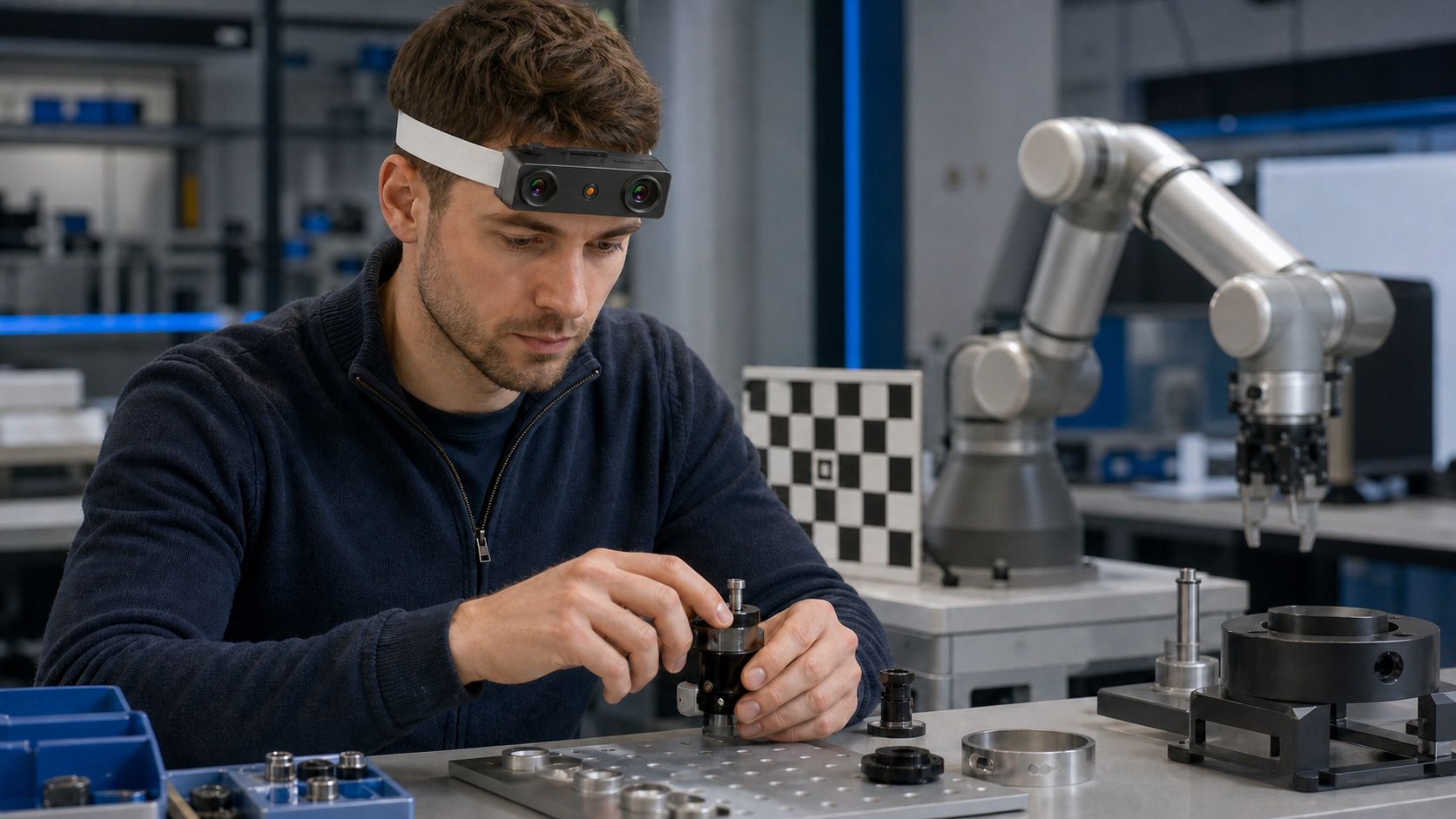
Robot learning depends on physical-world evidence that preserves what the wearer saw, how the viewpoint moved, and when each task event occurred. A head-mounted capture platform becomes an important part of the data pipeline when demonstrations include fast hands, tools, walking, and repeated changes of attention.
A Hampo Electronic engineering article discusses the importance of motion imaging and timing in head-mounted capture. This field guide focuses on EGO R9's confirmed configuration: 1080P global-shutter video, a 120-degree field of view, a 6-axis IMU above 200 Hz, a shared clock, and global timestamps.
Global shutter captures the complete image at one instant. During assembly, manipulation, walking, and inspection, this helps straight edges, object contours, and hand-tool relationships remain geometrically consistent through fast movement.
R9 records 1080P video at 30 FPS as its standard configuration. Optional 60 FPS and optional 1920 by 1200 configurations support project-specific evaluation. Teams can test representative task speeds and select a confirmed mode that provides useful hand detail and manageable storage requirements.
The 120-degree wide-angle view helps keep both hands, the active object, and surrounding workspace context in frame. The adjustable camera angle lets a team tune the view for a seated bench, standing assembly area, shelf route, or household task.
Vision becomes more informative when it is connected to motion. R9's 6-axis IMU samples above 200 Hz, adding accelerometer and gyroscope measurements between video frames. This supports detailed review of head turns, pauses, walking segments, and changes in viewpoint.
R9's shared clock and global timestamps provide a common time basis for its visual and inertial records. A pilot can check timestamp order, IMU continuity, video frame sequence, and the alignment of a visible movement with the corresponding motion interval.
Camera-intrinsics support helps preserve the imaging configuration used for geometric processing. Store the unit identifier, intrinsics file, firmware, selected video mode, camera angle, and task version with every session so repeated trials remain traceable.
A practical acceptance test records a calibration target, a fast moving object, normal head turns, a short walking loop, and a representative hand-object task. Review image geometry, hand visibility, exposure, frame continuity, IMU sample cadence, timestamp monotonicity, and file playback.
H.265 recording in an MP4 container, T-Flash storage, Type-C connectivity, microphone support, a replaceable strap, and external-battery support provide a practical foundation for repeated collection. The stated external-battery working time is approximately five hours and can be measured with the selected recording configuration.
For embodied-AI teams, EGO R9 combines motion-coherent global-shutter imagery, wide first-person context, high-rate inertial sensing, and shared timing in one wearable platform. That combination makes each recorded demonstration easier to inspect, segment, and organize for downstream robot-learning research.