
Embodied Intelligence / EGO R9 Field Notes / Aug 14, 2026
Beyond Better Models: Building Embodied Intelligence with Real-World Human Data
The next leap in robotics depends on more than stronger models. It requires structured, physically realistic data that teaches machines how people perceive, move, manipulate objects, and complete real tasks.
Artificial intelligence is moving beyond screens and software into machines that must perceive, decide, and act in the physical world. This transition marks the rise of embodied intelligence.
A robot must learn far more than what an object looks like. It must learn what to do next. That means understanding how people inspect a workspace, approach an object, coordinate their bodies, position their hands, apply force, use tools, verify results. These details are difficult to infer from conventional image collections or carefully staged third-person video.
Human experience contains the missing supervision. Every skilled action combines visual attention, motion, touch, timing, task intent, and environmental feedback. Yet this experience has historically been captured inconsistently, if at all. Future robot intelligence will increasingly be built on datasets that convert human behavior into synchronized, well-described, reusable learning assets.
A strong embodied-intelligence dataset begins with a repeatable first-person capture layer. The recording should preserve hands, tools, objects, head motion, task order, and enough surrounding context to explain how an operation develops over time.
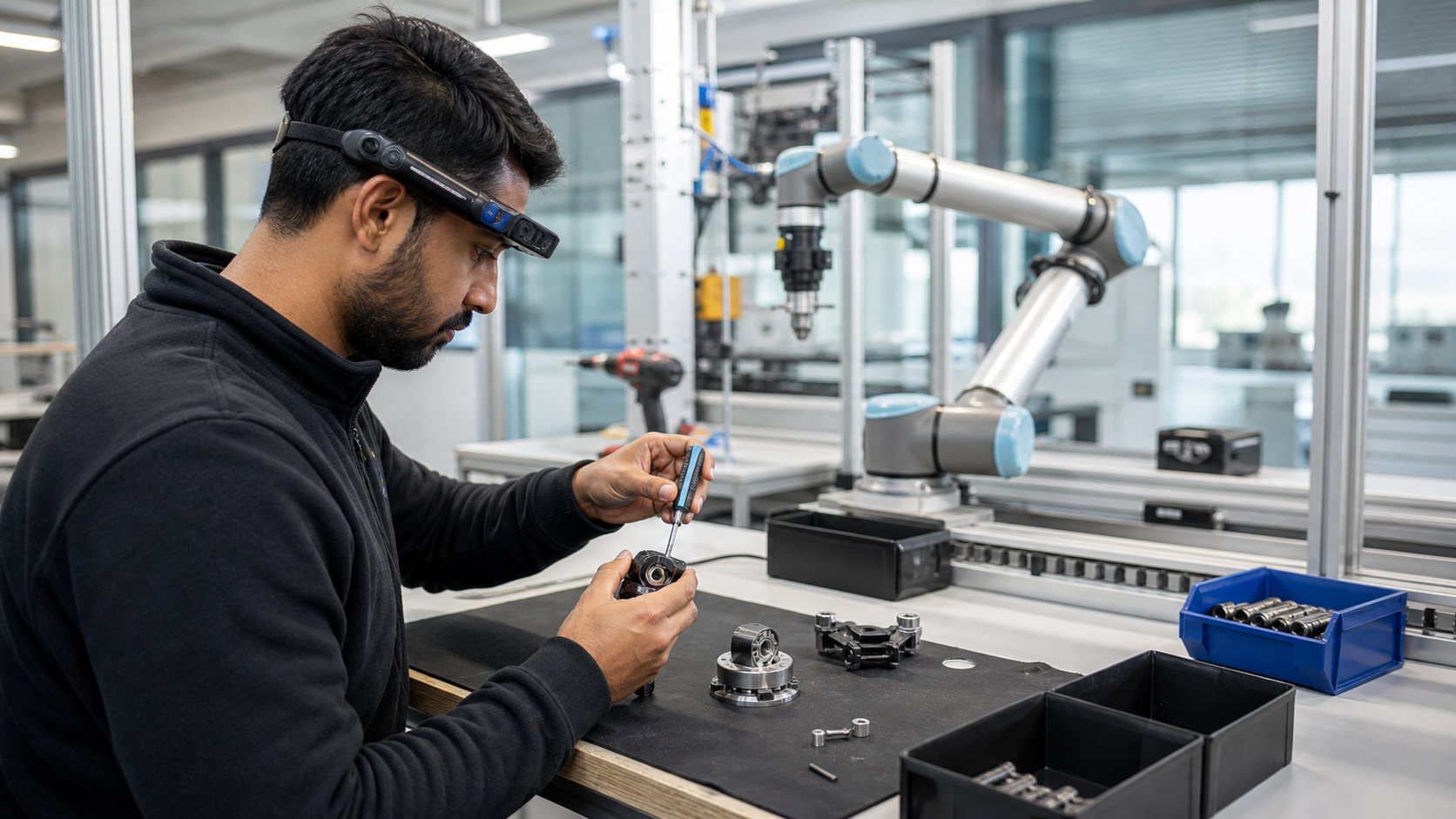
Within that system, ego-centric data provides the closest digital representation of how a person sees and acts. A head-mounted camera moves with the participant, keeping hands, tools, objects, and the active workspace inside the natural first-person field of view. Instead of observing an operator from across a room, the dataset follows attention and action through the complete task.
The EGO R9 is the ego-centric capture layer designed for this kind of real-world collection. Its hands-free head-mounted form allows participants to carry out familiar operations with minimal interruption. A 120-degree wide-angle view helps retain hand-object interactions and surrounding context, while 1080P global-shutter video is suited to motion-rich work where image distortion can reduce the value of fine manipulation evidence.
Vision becomes more useful when it can be aligned with movement and task events. EGO R9 combines first-person video with a 6-axis IMU sampling above 200 Hz, shared clock support, and global timestamps. These capabilities place head movement, image frames, spoken markers, and task annotations on a consistent R9 session timeline.
Consider a technician assembling a mechanical module. It is the full trajectory: locating the correct component, stabilizing the workpiece, choosing a tool, approaching at the right angle, applying controlled force, checking alignment, correcting an imperfect fit, and confirming completion. Ego-centric capture preserves the visual and procedural context that makes this human expertise teachable.
A dedicated processing workflow can turn R9 recordings into organized robot-learning assets. Useful steps include checking frame and IMU continuity, segmenting task stages, labeling objects and hand-object events, reviewing image quality, and storing the camera mode, intrinsics reference, timestamps, task version, and environment metadata with each sequence.
Consistency becomes increasingly valuable as collection expands. Use the same R9 camera-angle procedure, confirmed recording mode, unit identifier, T-Flash preparation, file naming, transfer check, and session manifest across participants and sites.
EGO R9 provides a practical bridge from human demonstration to structured physical-AI data. Its hands-free design, 1080P global-shutter imaging, 120-degree view, 6-axis IMU above 200 Hz, shared clock, and global timestamps preserve how people see, move, and complete real work in a repeatable first-person record.