
Human-to-Robot Learning / Spatial AI Daily / Ego2Robot / Aug 21, 2026
From Human Play to Precision Robot Skills: Maintenance Demonstrations with EGO R9
Ego2Robot shows that even short first-person demonstrations can become useful robot training signals after action retargeting, visual alignment, and quality control. EGO R9 can strengthen the capture layer for precision assembly and maintenance workflows.
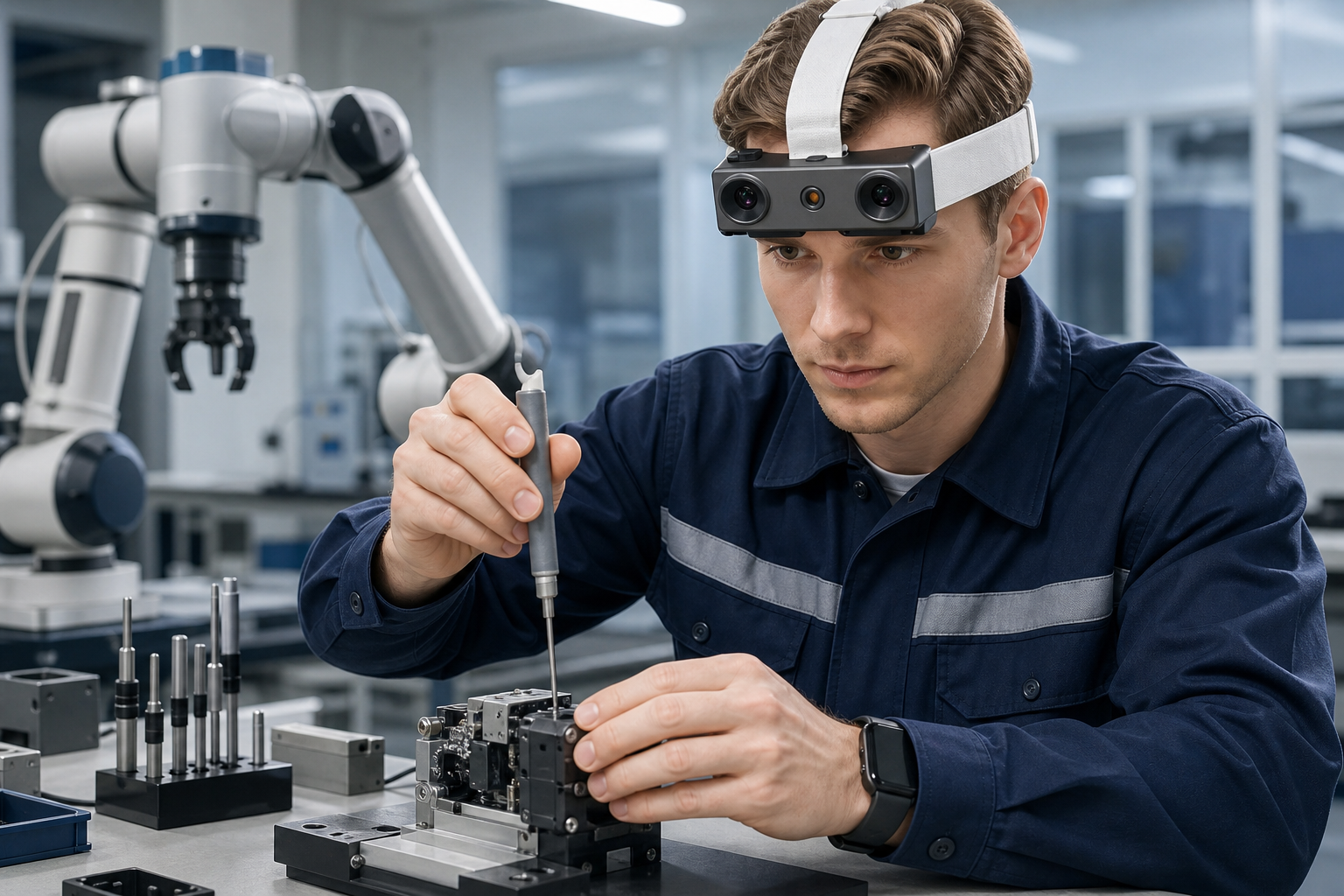
A technician seats a component, selects the correct bit, steadies the housing, tightens a fastener, checks alignment, and backs off when resistance feels wrong. This short maintenance sequence contains far more than a task label: it encodes gaze direction, hand approach, tool orientation, contact order, recovery behavior, and the visual evidence used to decide whether the assembly is correct.
An August 2026 analysis of Ego2Robot describes a scalable route for turning this kind of first-person human activity into robot-format training data. The research pipeline processed roughly 1,940 hours of egocentric video and produced 18,561 hours of synthesized demonstrations spanning 15 robot morphologies. Its central lesson is that human video becomes substantially more useful when the embodiment gap is handled explicitly rather than asking a robot policy to learn directly from raw footage.
Ego2Robot performs that translation in three stages. Action alignment estimates hand keypoints and retargets human motion to a virtual gripper trajectory. Visual alignment removes the human arm, searches for a feasible robot base pose, and renders a robot embodiment from the original camera viewpoint. A three-level quality system then rejects kinematic failures, discontinuous trajectories, and visually inconsistent results.
The precision-maintenance application is especially compelling. Screw fastening, connector insertion, small-part placement, inspection, and tool changes are repetitive enough to collect systematically but varied enough to expose a policy to different components, fixtures, lighting conditions, operator styles, and ordinary mistakes. The reported real-robot tests included long-horizon tasks such as folding a towel and tightening a screw, and found that adding converted first-person play data improved performance across the evaluated tasks.
EGO R9 can serve as the first-person capture layer for precision-maintenance programs. Its hands-free viewpoint keeps the operator's attention, hands, tool, and workpiece in a task-relevant frame. A 120-degree field of view retains context during reaching and tool changes, while 1080P global-shutter video preserves coherent geometry during quick hand movement.
R9's 6-axis IMU samples above 200 Hz, adding accelerometer and gyroscope data to the visual session. Shared clock support and global timestamps help organize approach, contact, tightening, verification, and correction along one recording timeline.
A practical pilot could begin with a narrow family of safe bench tasks: fastening two or three screw types, inserting keyed connectors, seating a bearing cover, or checking a fixture. Teams should record full successful sequences as well as safe corrections, vary objects and layouts deliberately, and define acceptance criteria for hand visibility, blur, occlusion, calibration, and task completeness before scaling collection.
Ego2Robot shows how action retargeting, visual alignment, and quality filtering can transform first-person demonstrations into structured research data. EGO R9 contributes motion-coherent imagery, wide task context, high-rate inertial sensing, and shared timing at the capture stage.
The larger opportunity is to make specialized human work reusable. By preserving the first-person geometry and timing of precision work, EGO R9 helps turn skilled maintenance demonstrations into structured raw material for more general robot learning.