
Humanoid Loco-Manipulation / Original EGO R9 field analysis informed by EgoHumanoid / Sep 7, 2026
Beyond the Workbench: Capturing In-the-Wild Humanoid Skills with EGO R9
EgoHumanoid moves human demonstration beyond tabletop manipulation into walking, reaching, carrying, and placing across real environments. EGO R9 can support similar field capture when viewpoint, route, timing, and task boundaries are designed together.
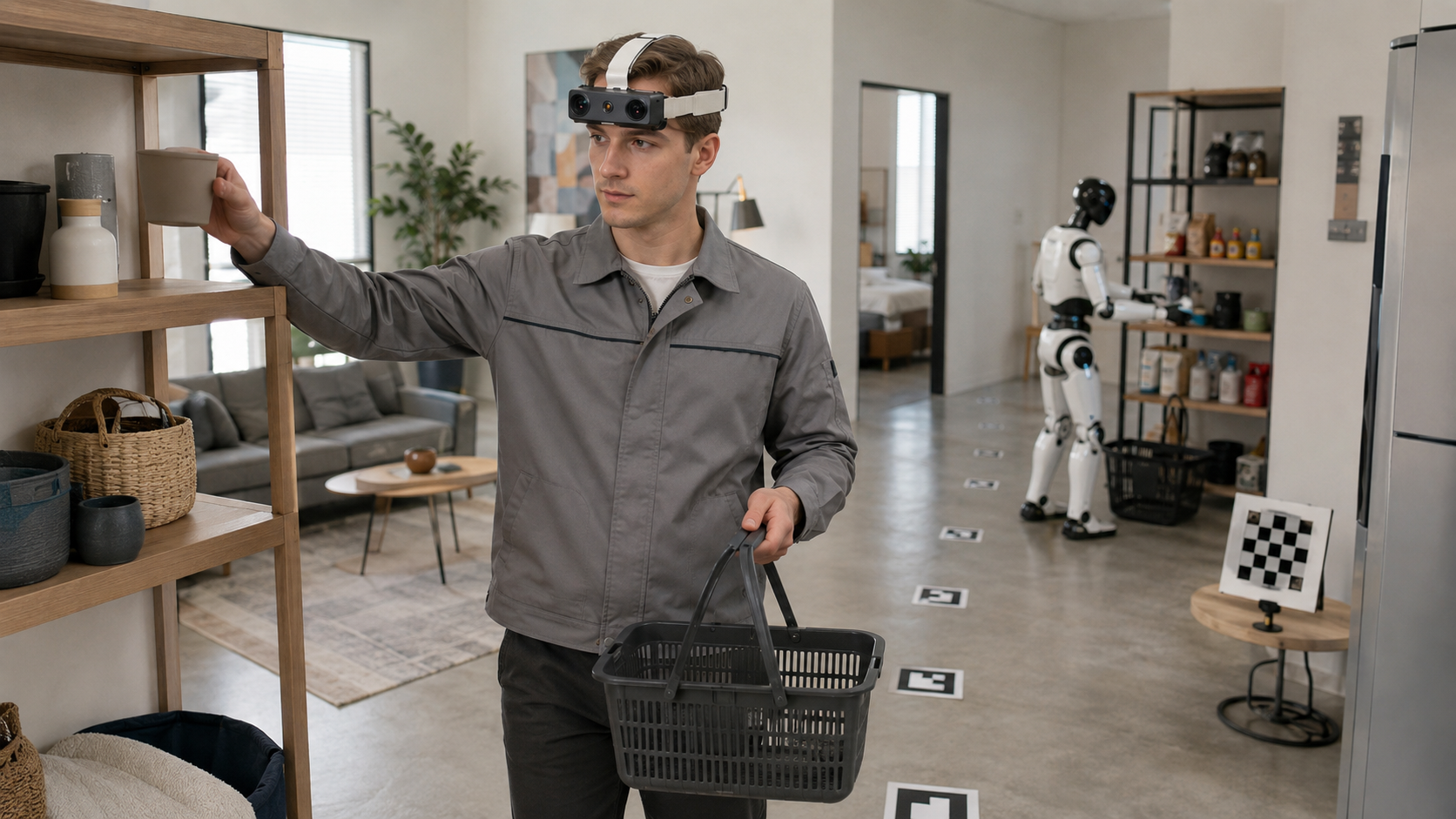
A service robot may walk from a pantry to a counter, carry a basket through a doorway, retrieve an object from a low shelf, and place it at a destination. These sequences combine navigation with manipulation, so the training record must preserve where the person moves, what the hands do, what remains visible, and how the environment changes across rooms.
The EgoHumanoid paper studies this broader problem through robot-free egocentric human demonstrations combined with a limited amount of robot data. Its authors describe a portable collection system and an alignment pipeline designed to reduce differences in human and robot viewpoint and to map human motion into a kinematically feasible action space. The paper reports a 51 percent improvement over robot-only baselines, particularly in unseen environments. That result is specific to EgoHumanoid; EGO R9 is discussed here as a separate capture platform for teams designing related field datasets.
The most important operational insight is that viewpoint is part of the task definition. If one participant records from eye level while another device points mostly at the floor, their clips may describe the same action with very different evidence. R9's head-mounted design follows the wearer's attention, its adjustable camera angle supports task-specific framing, and its 120-degree wide-angle view helps keep hands, carried objects, shelves, doorways, and nearby obstacles in context.
A useful pilot can connect several zones in one repeatable route. The wearer starts beside a storage shelf, selects an item, places it in a basket, walks through a doorway, transfers it to a counter, checks the result, and returns. Variants can change shelf height, item size, route direction, lighting, room layout, and whether one or both hands are occupied. The protocol should also capture safe pauses, replanning, and corrections rather than only flawless demonstrations.
Walking creates imaging conditions that tabletop tests often miss. Footsteps introduce repeated vertical motion; turns combine rotation and translation; hands may move independently while the whole body advances. R9's 1080P global-shutter video helps preserve coherent geometry during these motion-rich sequences, with 30 FPS standard and 60 FPS optional. Teams should test the chosen configuration during fast turns, doorway transitions, near-to-far focus changes, and the lowest approved light level.
The integrated 6-axis IMU, sampling above 200 Hz, adds head-motion measurements between video frames. This is useful when researchers need to examine walking cadence, stops, turns, and view changes alongside the visual record. Shared clock support and global timestamps help place image and inertial streams on one timeline, but projects that need a specific VIO or SLAM accuracy must calibrate, integrate, and benchmark their full pipeline rather than treating the sensor recording as a finished trajectory.
Mark a representative route and compare the human recording with the intended robot camera height and field of view. Check whether task-critical objects remain visible before contact, during transport, and at placement. Camera intrinsics support can assist geometric workflows, while a calibration board and known route markers provide repeatable acceptance tests. The final configuration and any calibration metadata should stay linked to every session.
Route-based collection also raises practical reliability questions. A Type-C connection is useful for live bench setup and pre-session checks; T-Flash support allows untethered capture along the route. H.265 recording can reduce storage demand relative to less efficient codecs, while microphone support can preserve approved spoken task markers. The replaceable strap and external-battery support suit repeated field sessions, subject to comfort, runtime, thermal, storage, and cable-routing tests in the real workspace.
Every session should pass two layers of review. Sensor review checks file integrity, frame continuity, IMU cadence, timestamps, audio when enabled, storage completion, and recovery after interruption. Task review checks route completion, hand and object visibility, correct state transitions, collisions or unsafe shortcuts, and whether the demonstration remains relevant to the target robot.
The collection plan must define consent, approved spaces, excluded objects, stopping rules, face and screen handling, retention, access, and permitted model uses.
It captures first-person visual and inertial evidence. The right product claim is therefore practical and specific: R9 helps teams collect hands-free, wide-angle, global-shutter video with high-rate motion data and shared timing across realistic mobile tasks.
Moving beyond the workbench requires a complete field protocol: define linked spaces and task states, align the camera view to downstream needs, validate motion and timing, test wearable reliability, preserve calibration and metadata, and review both sensor quality and human behavior. With those controls, EGO R9 can turn walking, reaching, carrying, placing, and correcting in everyday environments into structured source material for humanoid loco-manipulation research.