
Dexterous Robot Learning / Original EGO R9 analysis informed by NVIDIA GEAR EgoScale / Sep 7, 2026
What 20,854 Hours Teach Us About Capturing Dexterous Human Data with EGO R9
EgoScale links more than 20,000 hours of action-labelled human egocentric video to stronger dexterous transfer. For R9 teams, the practical lesson is to scale task diversity, visibility, timing, and quality controls together.
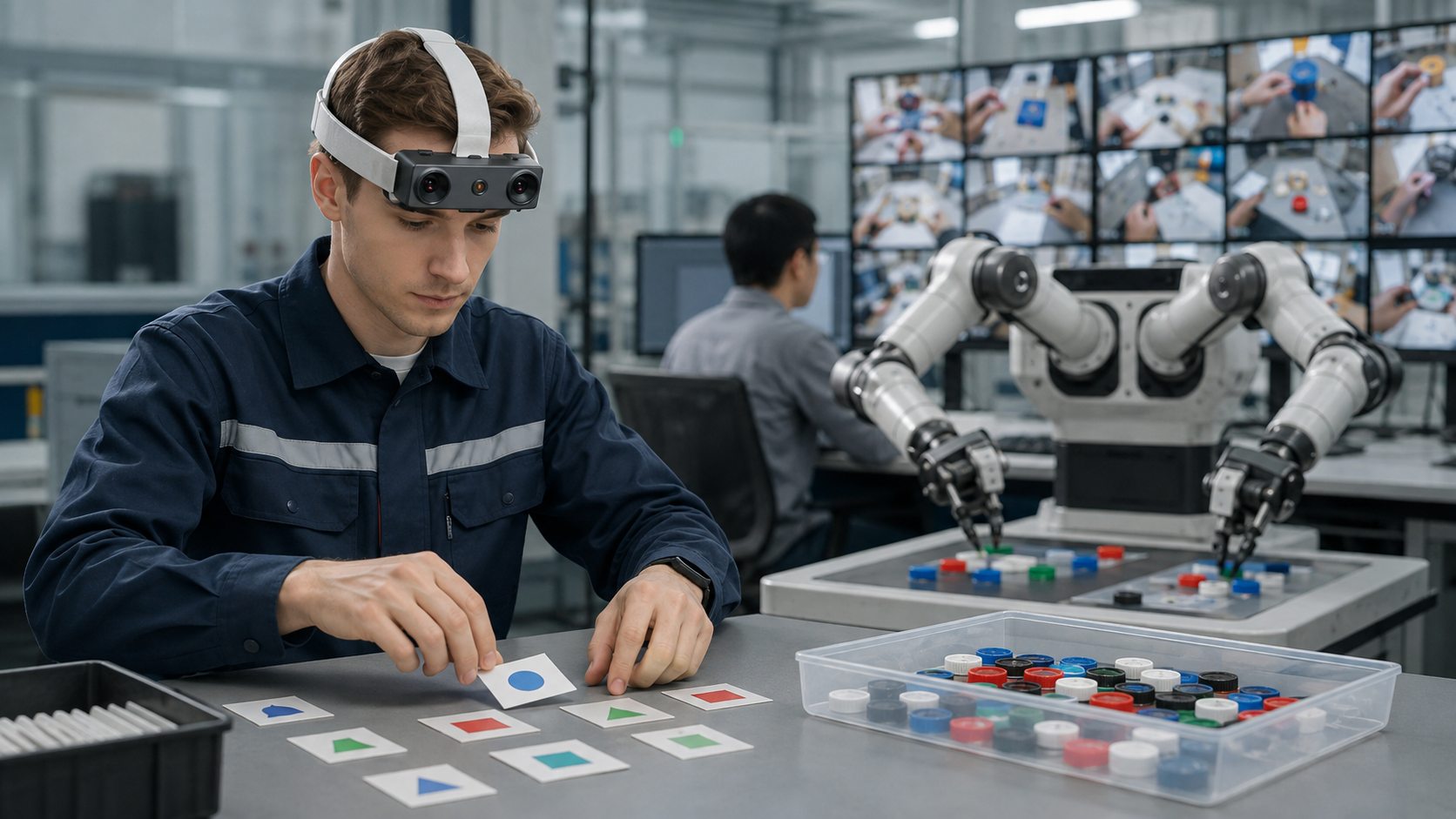
Dexterous robot learning demands more than examples of a hand reaching the correct object. A useful demonstration must preserve how the wrist approaches, how fingers change contact, how two hands coordinate, how the object moves, and how a person recovers when the first attempt fails. NVIDIA GEAR's EgoScale project provides unusually strong evidence that large, diverse egocentric human-video collections can become a scalable source of supervision for this problem.
EgoScale reports pretraining a vision-language-action model on 20,854 hours of action-labelled first-person human video. Its published results describe a near log-linear relationship between human-data scale and validation loss, followed by better real-robot performance as pretraining data grows.
A thousand nearly identical clips can leave a model brittle, while varied demonstrations expose different grasps, object poses, task orders, work surfaces, lighting conditions, participant habits, and corrections. An R9 collection plan can therefore begin with a task matrix: card sorting, bottle opening, cloth folding, tong use, parts placement, cable routing, container packing, and inspection. Each task should include normal completion, deliberate variation, and safe recovery from small errors.
EGO R9 keeps the capture viewpoint attached to the participant while leaving both hands free. Its 120-degree wide-angle lens helps retain the active object, two-handed coordination, and nearby workspace when the wearer looks between bins, tools, or task stages. The adjustable camera angle should be set for the actual bench height and working distance, then checked at the lowest reach, widest reach.
Rapid reaches, cap turns, card flips, and tool changes also test image geometry. R9 records 1080P global-shutter video at 30 FPS, with 60 FPS and 1920 by 1200 available as optional configurations. Global shutter helps avoid the line-by-line skew produced by rolling-shutter capture during fast motion.
Motion context between video frames can make the record more interpretable. R9's integrated 6-axis IMU samples above 200 Hz, capturing accelerometer and gyroscope measurements alongside the visual session. Shared clock support and global timestamps align head movement with image frames and task markers. Verify timestamp order, IMU continuity, axis conventions, and synchronization behavior on the final ordered configuration.
A scalable dexterity dataset also needs consistent segmentation. Define observable start and end states, then preserve intermediate stages such as approach, first contact, grasp adjustment, transport, placement, verification, and recovery. Spoken markers can be useful when microphone recording is approved, while visual markers or external logs can provide alternatives. R9 supports microphone capture and H.265 video in an MP4 container.
Collection logistics determine whether planned hours become usable hours. R9 supports Type-C connectivity for bench checks and T-Flash storage for wearable recording. A replaceable strap, adjustable viewing angle, and external-battery support suit repeated sessions; the specification states approximately five working hours with an external battery. Actual runtime, storage yield, temperature, comfort, and file recovery must be measured with the selected battery, memory card, frame rate, ambient conditions, and operator procedure.
Quality sampling should grow with the dataset. Review the first sessions in full, then use automated checks for corrupt media, missing streams, dropped or irregular frames, IMU gaps, non-monotonic timestamps, exposure failure, and abnormal duration. Continue human review for hand visibility, task correctness, unsafe behavior, privacy violations, and meaningful variation. A large collection with silent capture failures or duplicated behavior can be less valuable than a smaller, auditable one.
EgoScale also highlights the embodiment gap. Human and robot morphology, control rate, reachable space, viewpoint, and contact mechanics differ. R9 supplies first-person visual and inertial evidence; action extraction, wrist representation, human-robot alignment, policy training, and safety validation must be developed and evaluated separately.
The strongest R9 program would treat scale as a controlled expansion. Start with a diverse pilot, confirm the view and motion quality, document the device configuration and camera intrinsics, establish session metadata and consent, and test the intended downstream preprocessing. Add participants, tasks, sites, and hours only after acceptance metrics remain stable. That approach connects R9's global-shutter imaging, wide first-person view, high-rate IMU, shared timing, and field-ready storage to the real lesson of EgoScale: data becomes powerful when scale preserves structure rather than erasing it.