
Spatial Perception & 3D Reconstruction / Original EGO R10 guide; research context from Project Aria / Sep 23, 2026
EGO R10 for Spatial Perception and 3D Scene Reconstruction
Explore EGO R10 for spatial perception and 3D scene reconstruction: camera hardware synchronization, 1600 × 1200 imaging, stereo functions and IMU options.
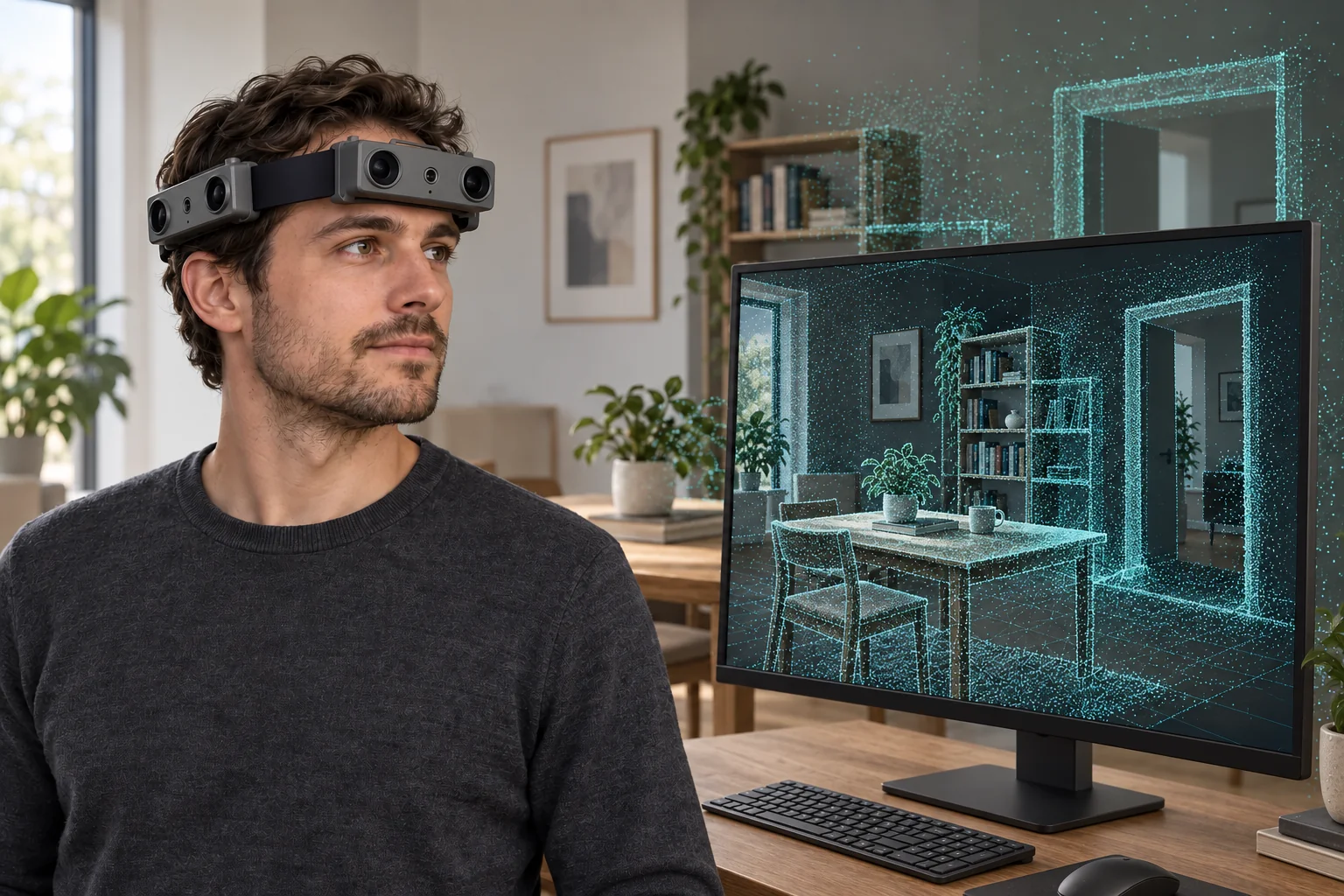
Which R10 features are relevant to 3D scene reconstruction?
- All cameras synchronize to a common hardware trigger/shutter signal.
- The imaging specification is 1600 × 1200 at 30 fps, with fixed-focus lenses.
- Listed functions include dual-camera ranging, calibration, depth detection and 3D reconstruction.
- A 6-axis IMU in head and wrist units where required offers 100 / 200 / 500 Hz sampling options.
EGO R10 brings a multi-camera headband and common camera hardware synchronization to first-person visual data collection. For teams evaluating capture hardware for spatial perception and 3D scene reconstruction, its relevant documented functions are dual-camera synchronization, ranging, calibration, depth detection and 3D reconstruction. This guide explains those functions alongside the imaging, video-output and inertial-sensing specifications that define an R10 collection configuration.
Research context: egocentric scene reconstruction
Project Aria: A New Tool for Egocentric Multi-Modal AI Research, by Jakob Engel and colleagues, provides the research background. Section 6.2 discusses reconstructing and understanding the surrounding scene from wearable first-person recordings. Figure 12 illustrates how the way a scene is recorded can affect reconstruction results. That research establishes the relevance of egocentric observations to scene reconstruction. The R10 characteristics discussed here come from its supplied manufacturer specification tables; the cited paper describes the Project Aria research system.
Common hardware synchronization across camera views
For a scene-reconstruction project, the first hardware question is how observations from different camera views are acquired together. R10 specifies that all cameras synchronize to a common hardware trigger/shutter signal. Its supplied product renders show camera units arranged around a headband. The combination of that arrangement and the documented shared capture signal is directly relevant when considering several first-person views of the surrounding scene. Camera identifiers and recording configuration belong in the research team’s collection records so the origin of each view remains clear.
1600 × 1200 imaging at 30 fps
R10 specifies 1600 × 1200 image resolution at 30 fps. Its sensor size is 1/2.6 inch, with 3.0 μm × 3.0 μm pixels. These values describe the image stream and sensor used to observe the scene. For an evaluation, the team can examine actual recordings at the intended subject distances and review the visibility of scene details before selecting material for reconstruction processing. Keep the recorded resolution and frame-rate configuration associated with the source files.
Field of view and fixed-focus scene capture
The documented lens field of view is 180° diagonal, 115° horizontal and 80° vertical. R10 uses fixed focus, with a lens TTL of 15.15 ± 0.3 mm. These are lens specifications to consider when reviewing how the selected camera views frame the surrounding environment. For a reconstruction-oriented evaluation, inspect the actual views and identify which scene regions appear in each one. This makes view selection an explicit research decision tied to the images being collected.
Document the imaging mode and controls
R10 lists a dynamic range of 61.56 dB in linear mode and 91.56 dB in HDR mode. Its automatic controls include saturation, contrast, acutance, white balance and exposure. These settings are relevant to documenting how scene appearance is recorded. A collection record can identify the selected imaging mode and controls alongside the footage, allowing researchers to relate their image review to a specific capture configuration. The listed dynamic-range values remain the manufacturer’s mode-specific specifications.
Ranging, calibration and depth-related functions
Dual-camera ranging, dual-camera calibration, depth detection and 3D reconstruction are explicitly included in the R10 function description. These are the documented product functions most closely aligned with this application. A technical discussion with the product team should therefore identify the camera configuration and the intended use of those functions. In the research workflow, keep the relevant camera-pair identifiers and calibration records associated with the selected recordings. This preserves the connection between the acquired views and the geometric processing carried out for the study.
Configure the 6-axis IMU option
R10 also specifies a built-in 6-axis IMU in head and wrist units where required. The listed sampling rates are 100, 200 and 500 Hz. For a project collecting inertial observations alongside visual recordings, the required unit configuration and sampling rate are concrete items to specify before evaluation. Record those choices with the session information. This keeps the description of the visual and inertial collection tied to the R10 configuration actually selected.
USB video output and external power
The video interface is USB 2.0, with MJPG, H.264 and H.265 listed as output formats. These specifications define the video-output choices to discuss when arranging acquisition and subsequent processing. R10 requires an external battery and specifies DC 5 V input with a maximum working current of 320 mA. Power and video-output configuration should be included in the equipment record for the evaluation, together with the original image files and the relevant camera identifiers.
Discuss an R10 reconstruction-focused evaluation
For spatial-perception and scene-reconstruction research, R10’s documented combination is specific: multi-camera capture with a common hardware trigger/shutter signal, 1600 × 1200 imaging at 30 fps, listed dual-camera geometric functions, USB video output and a configurable 6-axis IMU arrangement. Start the product enquiry with the required camera configuration, image mode, video format and IMU option. The EGO product team can discuss specifications and evaluation quantities around these requirements. Research methods and subsequent analysis remain described in the team’s own study documentation.
Research reference and manufacturer specifications
Project Aria — Jakob Engel and colleagues, 2023 (Section 6.2 and Figure 12)